Past Event
Kandy Esala Perahera
Location Kandy
Spread the word


Perahera is a Sinhalese word meaning a “procession”; there is probably a small “Perahera” of some sort celebrating some occasion or other somewhere in Sri Lanka every day of the week. But when Sri Lankans or the fast increasing corps of initiated tourists to whom Sri Lanka is a people rather than a place speak of the “Perahera” they mean one only; of all those hundreds of processions; The Kandy Esala Dalanda Perahera the procession in the great city in the lunar month called “Esala” honoring the Tooth Relic of Lord Buddha. Kandy, the last capital of the Sinhalese kings, despite all its beauty of situation was never a great city in the secular sense but the Tooth Relic is THE NATIONAL PALLADIUM AND CONFERS PRE-EMINENCE ON THE PLACE THATGUARDS.
There can be few spectacular as splendid as the Kandy “Esala” perahera. Yet it is far more than a spectacular; more even than a religious festival. With its roots in customs something over 2000 years old and its proper perpetuation a matter of concern, pride and delight to every mw=ember of the culture and ritual, the life and faith of a race. It is more than an artificially organized celebration; it is a living growth from a nation’s history and heart. Its beginnings are lost in time; they were probably humble, taking their origin from local honors paid to a shrime, from small circumambulations of a temple’s precincts such as a myriad culmination that summarizes the whole flowering of an ethos. It is the microcosm of the Sinhala nation not as purists and pandits, ethnologists, sociologists, theologian economists see it but it sees and feels itself.
Here is the PERAHERA
Involving sight, sound and scent of jasmine and incense, emotion and intellect; a total experience the “perahera” in its present form is theclimaxof a long sum of religious history already long complete when Sinhala kings still sat on their 2500 years old throne. It is in fact five separate processions; one each from the four great “Devales” of the Capital (deistic shrines to ancient divinities conceived of as themselves devotee and servants of the Buddha) and one, the chief and largest and most spectacular, from the Dalanda Maligawa, the palace of the Sacred Tooth.
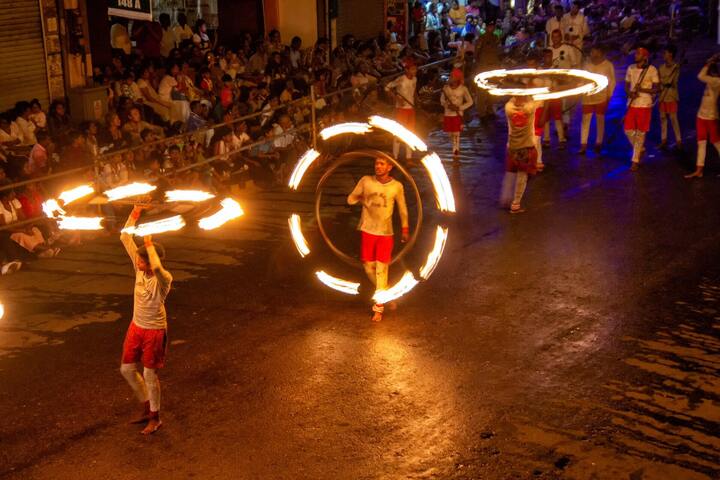
On the five nights preceding the “Perahera”, each of the “Devala” perehera has processed within the precincts of its own shrine. (Before each walked men who spun blazing torches to light and clear the way; at their hearts stepped the proud elephants that bore the symbolic weapons of the deities; immediately behind with a vanguard of dancers and flanked by attendants in traditional costume, trod the ‘devals’s chief trustee in the fantastic habiliments of a kandyan nobleman). But on the sixth night all assemble in order of precedence at the gate of the temple of the tooth, the processions of Esala, the defied Buddha to be. Tutelary of the city; “vishnu’, the appointed guardian of the island; “kathargama deviyo’, god of victory whose proportion considered peculiarly auspicious for this age; and of ‘pattini’, goddess of purity to be joined and led by the “Dalanda”cortege, to which all these are now subservient. On a signal of gunfire the combined “Perahera” moves and a first brief circuit of the city is made. But it is still not a spectacle it will become.
Torch – Spinners, Banners and standard bearers.
These in the time of the kings represented the districts of the kingdom as well as the chief of the noble houses.
More Events